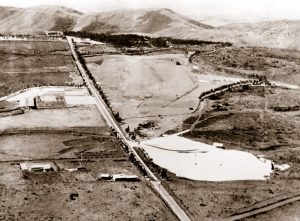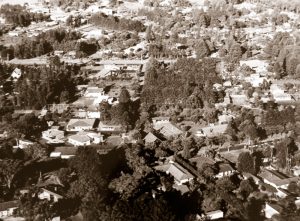



1958 – It all started when the “Quintas do Morro do Chapéu Neighborhood Unit” subdivision was created, with an urban design prepared by Silvio Vasconcelos, an architect and university professor. This was done to prevent the land from being expropriated by then-mayor Celso Melo Azevedo, who planned to use the water from the João Rodrigues Stream, which passed through the Morro do Chapéu Farm, to supply Belo Horizonte, the state capital.
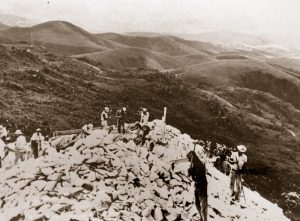
1970 – The Executive Boards of Morro do Chapéu and Cosim, the neighboring mining company, reached an agreement that allowed mineral deposits to be mined in exchange for construction works to collect, adduce, and store 250,000 liters of water per day. The catchment site was then silted up and the system shut down, with the plumbing removed around 1981.
1964 – MBR (Minerações Brasileiras Reunidas) was established in 1964 after Brazilian businessman Azevedo Antunes assumed control over two other mining companies: Mineração Morro Velho and Hanna Mining Corporation.
The 1990s – In the early 1990s, Antunes transferred control of the holding company (Caemi) to his grandchildren, which was later transferred to Japanese partner Mitsui and, subsequently, to Companhia Vale do Rio Doce. When MBR decided to install two large mines next to Morro do Chapéu – Tamanduá and Capitão do Mato –, Morro mobilized its people by setting up the Environmental Defense Committee and used it to work together with the general public to defend their rights and protect their future. This also led to a substantial increase in the value of Morro do Chapéu’s land.
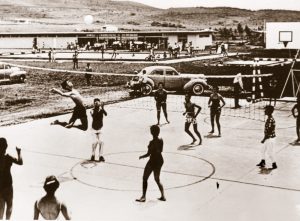
The present day – After more than 50 years, the compensation it received paid for the expansion of the Golf Course, the remodeling of the Social Center, and, subsequently, the new Sports Center with a heated pool, new sports courts, and a state-of-the-art security system.
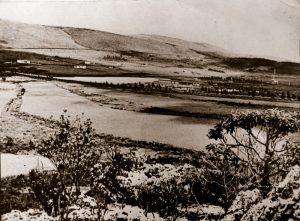 In the late 1940s, Heraldo de Campos Lima, a local physician, owned a farm in town of Raposos, where he raised livestock. It was close to Morro do Galo, where Saint John D’el Rey Mining had an arsenic processing plant, used to process an ore byproduct from which gold was extracted. Legend has it that Lima filed a lawsuit against the mining company claiming his animals were dying because the wind carried arsenic dust from the plant and contaminated his cattle pastures. Although the company denied the allegation, it accepted an exchange of land of the doctor’s choosing, which was called Morro do Chapéu because a nearby mountain peak was shaped like a hat.